
UK Home Buying Guide – Your House Purchase Journey in 2025

Getting Your Finances in Order
Buying a home is a big financial step, so preparing your money before you start searching will make the process smoother and less stressful.
Understand Your Budget and Affordability
Work out what you can realistically afford before speaking to estate agents. Lenders will look at your income, your monthly spending, and any existing debts. A simple way to start is by checking how much you spend on essentials each month and what is left over for mortgage payments. Most lenders allow you to borrow up to 4.5 times your annual income, but the exact figure depends on your personal situation.
Save for Your Deposit
You need a deposit of at least 5 percent of the property’s price. Larger deposits, such as 10 or 15 percent, often lead to better mortgage deals and lower monthly repayments.
Ways to save more effectively:
-
Set up a standing order to a savings account each month.
-
Look into Lifetime ISAs, where the government adds a 25 percent bonus on savings up to £4,000 a year.
-
Reduce non-essential spending to put more aside.
For example, on a £200,000 home, you need at least £10,000 for a 5 percent deposit, but if you save £20,000 you will have more mortgage options and lower costs over time.
Check and Improve Your Credit Score
Your credit score plays a key role in securing a mortgage. Lenders use it to judge how reliable you are with repayments.
Steps to improve your score:
-
Register on the electoral roll.
-
Pay bills on time.
-
Reduce credit card balances.
-
Avoid taking out new credit before applying for a mortgage.
You can check your score with agencies like Experian, Equifax, or TransUnion for free.
Explore Mortgage Options and Schemes
Different mortgages suit different buyers. Common types include:
-
Fixed-rate: Your interest rate stays the same for a set period, usually two to five years.
-
Variable-rate: Your payments change in line with the lender’s rate.
Government schemes can also help. Shared Ownership allows you to buy a share of a property and pay rent on the rest. The First Homes scheme offers discounts of at least 30 percent for first-time buyers on certain new builds.
Get a Mortgage Agreement in Principle (AIP)
An Agreement in Principle shows how much a lender is prepared to lend you. It is not a final mortgage offer but helps you set a budget and shows sellers you are a serious buyer. You can usually get an AIP online or through a mortgage adviser. Having one in place before viewing properties makes you more credible when making an offer.
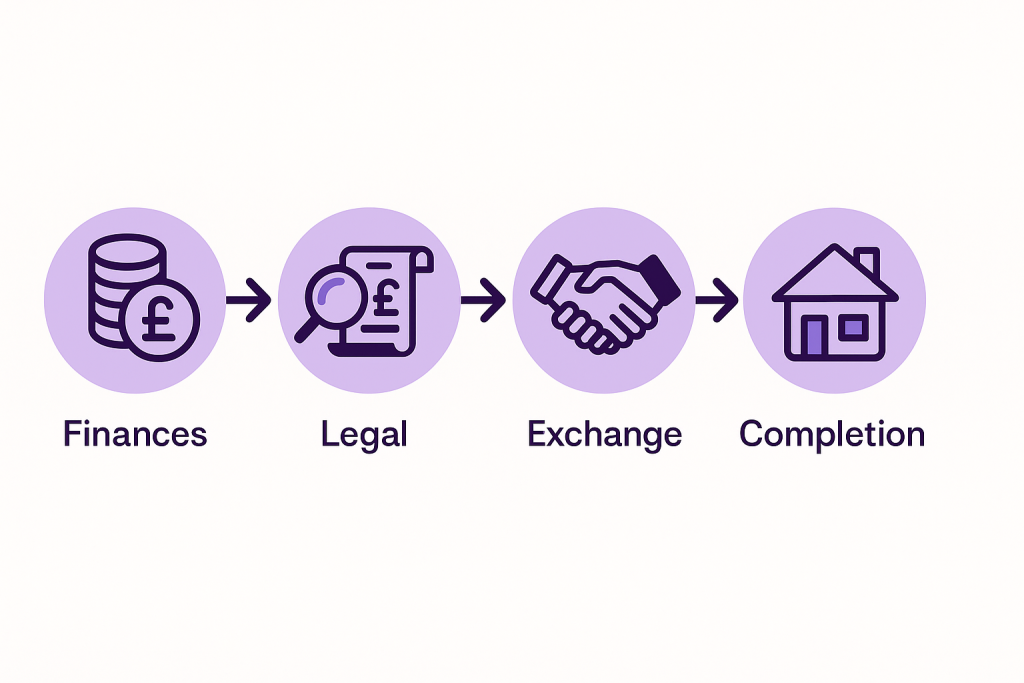
The Search and the Offer
Once your finances are in order, it is time to focus on finding the right property and putting in an offer that gets accepted.
Define Your Must-Haves vs. Nice-to-Haves
Before you start searching, write two lists. One for essentials, such as the number of bedrooms, location, and budget. Another for features you would like but are not deal-breakers, such as a garden or off-road parking. This helps you stay focused and avoids wasting time on properties that do not suit your needs.
Start Your Property Search
There are two main ways to look for homes:
-
Online portals: Websites like Rightmove and Zoopla allow you to set filters for price, location, and features. Set up alerts so you hear about new listings quickly.
-
Local estate agents: Register with agents in the area you want to buy. They often contact registered buyers before properties go online.
Keep track of properties you view online by saving favourites and comparing them side by side.
View Properties Like a Professional – what to look out for
When you view a property, look beyond the furniture and decoration. Focus on the structure and condition. Ask questions such as:
-
How old is the boiler and when was it last serviced?
-
Has the property ever had damp problems?
-
What is included in the sale?
Look for red flags such as cracks in walls, signs of damp, or a roof in poor condition. Take notes and photos if the seller agrees so you can review later.
Making a Compelling Offer
Once you find the right property, decide on a fair offer. Research similar homes sold nearby to get an idea of value. Your estate agent will pass your offer to the seller.
Tips for making your offer stronger:
-
Show proof of your mortgage Agreement in Principle.
-
Be clear on your position, for example, being a first-time buyer with no chain.
-
Make an offer slightly below the asking price if you think there is room to negotiate, but stay realistic to avoid losing the property.
If your first offer is rejected, be prepared to increase it within your budget. Do not overstretch yourself, as you will need money for fees and future repairs.

The Legal and Financial Process
When your offer is accepted, the purchase moves into the legal and financial stage. This part can feel complex, but breaking it into clear steps makes it manageable.
Appoint a Conveyancer or Solicitor
A conveyancer or solicitor handles the legal side of your purchase. They check contracts, manage funds, and ensure the property is legally transferred to you.
How to choose one:
-
Ask friends or family for recommendations.
-
Compare quotes and check if fees are fixed or hourly.
-
Confirm they are regulated by the Solicitors Regulation Authority (SRA) or the Council for Licensed Conveyancers (CLC).
A good conveyancer keeps you updated and explains the process clearly. Communication is key, so make sure you feel comfortable with them.
Formally Apply for Your Mortgage
With an accepted offer, you now submit your full mortgage application. Lenders will ask for documents such as:
-
Payslips and bank statements (usually the last three months)
-
Proof of ID and address
-
Details of existing loans or credit agreements
-
Your Agreement in Principle
The lender may also arrange a valuation to confirm the property is worth the agreed price. This valuation is for their security, not yours, which is why a separate survey is important.
Arrange Property Searches
Your conveyancer will order searches to uncover any issues that could affect the property. The main ones are:
-
Local authority search: Checks planning permissions, building control, and nearby developments.
-
Drainage and water search: Confirms connections to sewers and water supply.
-
Environmental search: Identifies risks like flooding, land contamination, or subsidence.
These searches protect you from unexpected problems and can influence your decision to move forward.
Get a Property Survey
A survey gives you an independent assessment of the property’s condition. RICS surveys come in three levels:
-
Level 1 (Condition Report): Basic overview, best for new builds or modern homes.
-
Level 2 (HomeBuyer Report): Most common option, checks visible issues like damp, subsidence, or roof defects.
-
Level 3 (Building Survey): Most detailed, recommended for older or unusual properties, or when planning major renovations.
The survey provides a traffic light system: green for good, amber for potential future issues, red for urgent problems. Use the findings to renegotiate or request repairs before contracts are exchanged.
Understanding and Securing Home Insurance
Most lenders require buildings insurance from the moment you exchange contracts. This protects the structure of the property against risks such as fire, flooding, and storm damage.
Tips for arranging cover:
-
Shop around using comparison sites and check reviews for reliability.
-
Make sure the policy covers the full rebuild cost, not just the market value.
-
Consider adding contents insurance to protect personal belongings.
Having the right insurance in place means you are covered if anything happens between exchange and completion.

Exchanging Contracts and Completion
This stage finalises your purchase. Once contracts are exchanged, the deal is legally binding, and completion follows shortly after.
Exchanging Contracts
Your solicitor or conveyancer and the seller’s solicitor agree on a completion date. You will sign the contract and pay your deposit, usually 10 percent of the purchase price. At this point:
-
Both sides commit to the sale.
-
If you pull out after exchange, you lose your deposit.
-
Buildings insurance must already be in place.
Exchanging contracts provides certainty that the property is now secured for you.
Final Preparations
Before completion, make sure you are ready to move. Key tasks include:
-
Booking removals or hiring a van.
-
Completing a final walkthrough to check the property’s condition.
-
Confirming transfer of utilities into your name.
-
Preparing funds for any outstanding fees, such as stamp duty or solicitor costs.
Having everything organised avoids stress on moving day.
The Completion Day
Completion is the final stage of the home buying process and the moment ownership officially transfers to you. It usually takes place on the date agreed during exchange of contracts, and both your solicitor and the seller’s solicitor work to make sure everything goes smoothly.
What happens on the day:
-
Your solicitor sends the remaining balance of the purchase price to the seller’s solicitor. This is done by bank transfer and includes the mortgage funds released by your lender as well as any money you are contributing personally.
-
Once the seller’s solicitor confirms the funds have been received, the estate agent is instructed to release the keys to you.
-
From this moment, the property legally becomes yours. You are free to move in, arrange deliveries, or begin any planned work.
Timing of completion:
-
Most completions take place around midday, but it depends on when the funds clear.
-
If you are in a chain, the timing may shift slightly as each sale must complete in order. This sometimes causes delays, so patience is important.
-
Your solicitor should keep you updated throughout the day. It is worth keeping your phone nearby so you do not miss any updates.
Practical tips for completion day:
-
Have your removal company or van on standby but allow for flexibility in case of delays.
-
Keep important documents, valuables, and essentials (such as phone chargers, toiletries, and a change of clothes) with you rather than in the moving van.
-
Take meter readings as soon as you enter the property and inform your utility providers.
-
Check the property against the agreed fixtures and fittings list to ensure nothing has been removed that should have been left behind.
Completion day is often busy, but it is also exciting because it marks the moment you finally take ownership of your new home. By staying organised and keeping in close contact with your solicitor and removals team, you can make the transition as smooth as possible.


